
LLC vs Sole Proprietorship: Which Is Better in the U.S.?
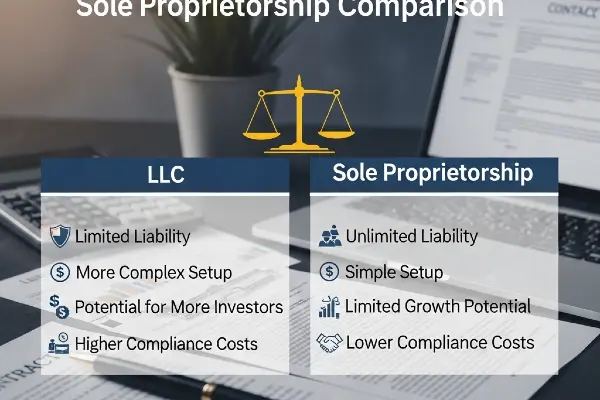
If you’re starting a business, one of the first decisions you’ll face is this: should you go with an LLC or stay a sole proprietor?
Both options are common in the United States, and both can work. The better choice depends on how you plan to run your business, how much risk you’re taking on, and how you want to handle taxes and structure.
What Is a Sole Proprietorship?
A sole proprietorship is the simplest business structure.
It means:
- You and your business are legally the same
- There’s no formal registration required (in most cases)
- You report income on your personal tax return
It’s the default setup for freelancers, side hustles, and small solo businesses.
What Is an LLC?
An LLC (Limited Liability Company) is a separate legal entity from you as an individual.
It offers:
- Legal separation between you and your business
- Protection of personal assets (in most cases)
- Flexible tax options
Forming an LLC requires registration with your state and some ongoing compliance.
Key Difference: Liability Protection
This is the biggest distinction.
Sole Proprietorship
You are personally responsible for everything.
If your business faces:
- Lawsuits
- Debt
- Legal claims
Your personal assets (bank account, savings, property) may be at risk.
LLC
Your business is treated as a separate entity.
That means:
- Your personal assets are generally protected
- Only business assets are at risk (with some exceptions)
This protection is one of the main reasons people choose an LLC.
Taxes: How Do They Compare?
Taxes are often similar, but there are some differences.
Sole Proprietorship
- Profits are taxed as personal income
- You pay self-employment taxes
- Simple tax filing
LLC
By default:
- Also taxed as pass-through income (like a sole proprietor)
However, an LLC can choose different tax options, such as:
- S-Corp taxation (in some cases, this can reduce taxes)
This flexibility can be useful as your business grows.
Setup and Costs
Sole Proprietorship
- Minimal setup
- Usually no state filing required
- Low or no cost to start
LLC
- Requires state registration
- Filing fees (varies by state)
- Possible annual reports or fees
An LLC involves more effort upfront, but it’s still relatively straightforward.
Credibility and Professional Image
How your business looks to others can matter.
Sole Proprietorship
- Seen as informal
- May feel less established
LLC
- Adds a layer of professionalism
- Can build trust with clients and partners
- Often preferred for contracts and business deals
When Should You Choose a Sole Proprietorship?
A sole proprietorship may be enough if:
- You’re testing a business idea
- You have low risk (no major liabilities)
- You’re working alone
- You want the simplest setup possible
It’s a good starting point for many people.
When Should You Choose an LLC?
An LLC makes more sense when:
- You want to protect your personal assets
- Your business involves risk (clients, contracts, products)
- You’re earning consistent income
- You want a more professional structure
Many businesses eventually switch to an LLC as they grow.
Common Mistakes to Avoid
- Assuming a sole proprietorship offers any liability protection
- Forming an LLC but not keeping finances separate
- Ignoring state requirements for LLC maintenance
- Choosing based only on cost instead of risk
Small decisions early can have big consequences later.
Final Thoughts
There’s no one-size-fits-all answer to LLC vs sole proprietorship in the U.S. It comes down to risk, simplicity, and long-term goals.
If you want something quick and easy, a sole proprietorship works. If you want protection and a stronger business structure, an LLC is usually the better move.
Understanding the difference now can save you from bigger problems down the road.