
Affidavit of Indigency Meaning Uses and Process 2026
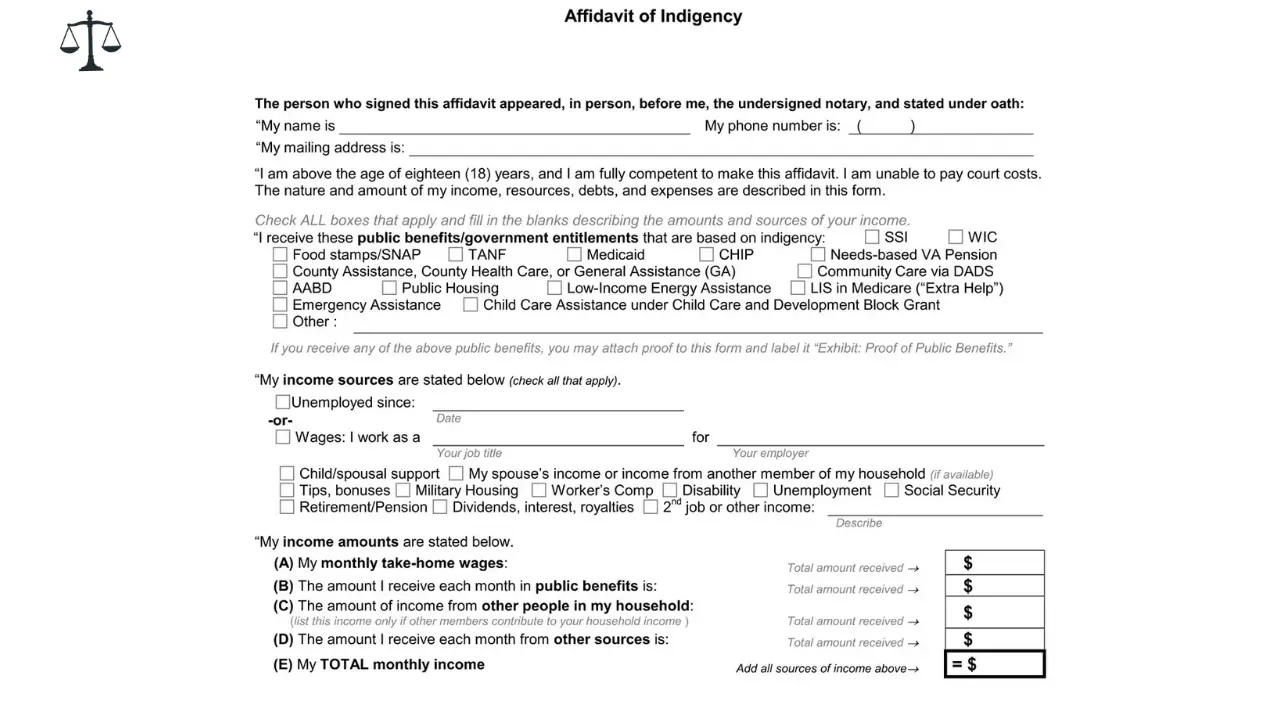
An affidavit of indigency is a sworn statement asking a court to recognize that a person cannot afford certain legal costs. It is usually used to request a waiver or postponement of filing fees, service fees, transcript costs, or other court charges. It is not itself a lawsuit, a class action, or a settlement claim. Instead, it is a procedural tool that may allow an eligible person to start, defend, or appeal a case without paying all required costs upfront.
The name, required information, and legal effect of this document vary by state and court. Some courts use terms such as “application to proceed in forma pauperis,” “fee waiver application,” “statement of inability to afford payment of court costs,” or “pauper’s affidavit.” This article explains the general purpose of the document, what courts may consider, and how to avoid common mistakes without offering individualized legal advice.
What Is an Affidavit of Indigency?
An affidavit of indigency is a signed declaration, often made under oath or penalty of perjury, describing a person’s financial circumstances and asking the court for relief from specified costs. “Indigency” generally means an inability to pay court-related expenses without substantial hardship, but the exact legal standard depends on the applicable law and court rules.
A court may grant the request in full, grant it only for certain fees, defer payment until later, require additional proof, or deny the request. Filing the affidavit does not automatically establish that a person qualifies. A judge, clerk, or other authorized court official may review the information under local procedures.
What an Affidavit of Indigency Is Used For
The affidavit is most commonly connected to access to the court system. A person may need it when bringing a civil case, responding to one, seeking an appeal, or requesting records needed for a legal matter. The form does not decide whether the person will win the underlying case.
- Filing a civil action: A person may ask to file a complaint without paying the initial filing fee.
- Defending a case: Depending on the jurisdiction, a party may seek help with required court costs while responding to a lawsuit, eviction, family-law case, or other proceeding.
- Appealing a decision: An appellant may request a waiver of appeal-related fees or, where authorized, help with record or transcript expenses.
- Service of process: Some courts may address costs for serving legal papers on another party.
- Obtaining court records: In limited circumstances, a court may consider a request involving copies, transcripts, or other records. The rules can be especially narrow for these costs.
Is an Affidavit of Indigency a Lawsuit or Class Action?
No. An affidavit of indigency is not a lawsuit, a class action, a settlement, or a finding that any party did something wrong. It is a request about a person’s ability to pay court costs in connection with a legal proceeding.
Someone may file an affidavit in an individual case or in a case that is described as a proposed class action. That does not make the affidavit itself a class action, and it does not mean a class has been certified. Class certification is a separate court decision governed by specific legal requirements.
Likewise, there is no general “affidavit of indigency settlement.” If an online advertisement or social-media post suggests that people can collect money simply by completing such an affidavit, readers should be cautious. Legitimate settlements ordinarily have case-specific court documents, official notices, defined eligibility terms, and stated deadlines.
What Information Is Usually Included?
Courts commonly provide their own form. A typical affidavit of indigency asks for a clear picture of the applicant’s finances, often including income, household size, assets, expenses, debts, and public benefits. Requirements differ, so the court’s current form and instructions should control.
| Information category | Examples a court may request |
|---|---|
| Identity and case information | Name, contact information, case number if one exists, and the requested fee relief |
| Income | Wages, self-employment earnings, unemployment benefits, disability benefits, child support, pensions, or other regular income |
| Household information | People supported by the applicant and, in some courts, a spouse’s or household member’s financial contributions |
| Assets | Cash, bank accounts, vehicles, real property, investments, and other property, subject to the form’s instructions |
| Expenses and debts | Housing, food, utilities, transportation, medical costs, child care, loans, and other necessary obligations |
| Public assistance | Participation in qualifying benefit programs, where the court’s rules treat this as relevant |
How the Court May Review a Request
There is no single nationwide test for indigency in state courts. A court may consider total financial resources, necessary expenses, dependents, available assets, the size of the requested cost, and eligibility for certain public-assistance programs. Federal courts use their own procedures for requests to proceed in forma pauperis, a Latin term generally meaning permission to proceed as a person unable to pay costs.
In some places, the clerk may initially review the paperwork. In others, a judge decides the request. The court might approve the request based on the written form, schedule a hearing, ask for pay stubs or account information, or issue an order explaining what fees remain due.
Approval Does Not Always Mean Every Cost Is Waived
A granted application may be limited. For example, a court could waive an initial filing fee but later require payment for a particular service, copy, transcript, or other expense. The order granting relief, rather than the applicant’s assumptions, determines what the court has approved.
A Denial Does Not Decide the Underlying Case
If a court denies an affidavit of indigency, that ruling generally addresses ability to pay costs, not the merits of the lawsuit or defense. The court may provide a deadline to pay the fee, submit a corrected form, or seek review under the procedures that apply in that jurisdiction. Missing a stated deadline can affect the case, so court notices should be read carefully.
How to File an Affidavit of Indigency
The safest approach is to use the form issued by the court where the case will be filed or is already pending. State courts, county courts, federal district courts, appellate courts, and specialized courts may have different forms and filing practices.
- Identify the court and obtain its current fee-waiver or indigency form.
- Read the instructions, including whether notarization, a declaration under penalty of perjury, supporting documents, or a hearing is required.
- Complete the form accurately. Do not estimate or leave required financial information blank unless the form instructs otherwise.
- File it with the clerk according to the court’s rules, often at the same time as the complaint, notice of appeal, or other initiating document.
- Keep a copy of the completed filing and any receipt, stamped copy, electronic confirmation, or court order.
- Respond promptly if the court requests more information or sets a hearing.
Electronic filing rules differ. Some courts allow self-represented parties to file online, while others require paper filing or use a clerk-assisted process. Court staff may be able to explain filing procedures, but they generally cannot provide legal advice or tell a person how to answer financial questions.
Documents That May Help Support the Request
Only provide documentation requested by the form, court, or judge. When supporting evidence is required, it may include recent pay information, benefit letters, bank statements, proof of recurring expenses, or documentation of dependents. Sensitive records should be handled carefully, and filers should follow the court’s redaction rules for account numbers, Social Security numbers, and other private information.
A person should not alter documents or provide information that is incomplete or misleading. Because an affidavit is a sworn or certified statement, false information can carry serious legal consequences, including sanctions or possible criminal penalties in some circumstances.
Differences Between State and Federal Procedures
Terminology can be confusing because the same goal is described differently across the United States. An “affidavit of indigency” may be a state-court form, while a federal court may use an application to proceed without prepaying fees or costs. Some states have special procedures for criminal appeals, family-law matters, evictions, probate cases, or administrative appeals.
Federal rules may also impose additional requirements in particular types of cases. For example, incarcerated people bringing certain federal civil actions can face rules that differ from those for other applicants, including payment obligations over time. This is one reason general online guidance cannot replace the instructions for the specific court and case type.
Is There an Affidavit of Indigency Settlement?
No general settlement exists for an affidavit of indigency. The document is not a consumer product, company, or legal claim with a universal settlement fund. It is a court filing used to request relief from fees in an individual legal matter.
A particular lawsuit in which someone files an indigency affidavit could later settle, but that would be a settlement in that separate case. Whether any settlement exists, who is covered, and whether a claim deadline applies can be verified only through the case’s official court filings and settlement materials. An affidavit alone does not create a right to payment.
What Should Consumers and Court Users Know?
First, use the correct court form and provide current financial information. Many denials or delays result from missing signatures, unanswered questions, incomplete income details, or filing in the wrong court.
Second, keep records. Save copies of the application, supporting documents, filing confirmation, court notices, and any order granting or denying fee relief. If your financial situation changes and the court’s rules require an update, follow those requirements.
Third, be careful with websites that charge for generic forms or promise a guaranteed waiver. Courts frequently make their own forms and instructions available through their clerk’s office or official court channels. A paid form service cannot guarantee that a court will find someone indigent.
Finally, an approved fee waiver usually does not provide a lawyer. People who need legal help may be able to contact a local legal-aid organization, bar association referral service, law-school clinic, or court self-help center. Availability and eligibility vary by location and legal issue.
Current Status of an Affidavit of Indigency
An affidavit of indigency has no single nationwide “case status” because it is not one case. Its status is determined within the individual court matter in which it is filed. The court’s docket, clerk’s office, and written orders are the most reliable sources for whether a particular request is pending, granted, denied, or requires additional action.
For an existing lawsuit or appeal, review the caption and case number on the court papers before looking for records. A similar case name, an old web page, or an advertisement is not reliable proof that a fee-waiver request or settlement remains active.
Frequently Asked Questions
What is an affidavit of indigency?
It is a sworn or certified request asking a court to waive, reduce, or defer certain court costs because the applicant cannot afford them. The applicable court decides whether the request meets its rules.
Does an affidavit of indigency mean I do not have to pay anything?
Not necessarily. A court may waive only particular fees, defer payment, or deny some requested costs. Attorney fees and many litigation expenses are not automatically covered.
Is an affidavit of indigency a class action?
No. It is a financial-status filing in an individual legal matter. It does not create or certify a class action.
Is there a settlement or claim deadline?
There is no general affidavit of indigency settlement or claim deadline. Deadlines, if any, depend on the separate case and the court’s orders.
Can a court deny an affidavit of indigency?
Yes. A court may deny the request if it determines the applicant does not qualify, if information is missing, or for other reasons under its rules. A denial generally does not decide the merits of the underlying legal dispute.
How can I verify the requirements in my case?
Check the official website or clerk’s office of the court handling the matter, review the court’s current forms and orders, and consider qualified legal assistance for advice about your specific situation.
Conclusion
An affidavit of indigency is a court procedure for requesting help with legal costs, not a lawsuit, class action, or settlement program. It requires truthful financial disclosure, and approval depends on the rules of the particular court and the applicant’s circumstances. No general settlement or payment is associated with the form. For a specific matter, the court’s official instructions and written orders provide the best information about required documents, deadlines, and the current status of the request.